
We hear it almost every day: somewhere in your 40s, something shifts.
Maybe it’s that the hike you used to do on a whim now costs you two days. Maybe it’s watching your mother reach for a handrail she never used to need, or hearing that a neighbor broke a hip and never really came back from it. Maybe your kids are finally old enough that you have your Saturdays back, and you’d like to spend them the way you used to.
Or maybe it’s that strength training for women over 40 is suddenly everywhere — every podcast, every feed — and you’ve gathered you’re supposed to be lifting, without knowing why, how much, or whether heavy weights are safe.
Here’s the short version.
What’s happening is real. It starts earlier than you might think, and it’s also one of the most modifiable things in all of medicine. We can’t stop the clock, but we can slow these losses down and often reverse a good portion of them.
If you’re not a gym person, stay with us. This is more approachable than you think, and the dose is smaller than most people realize.
What changes, and what it costs you
Most women have absorbed some version of this story:
- You get slower, weaker, and more injury-prone as you age, and your metabolism slows down along with you.
- Menopause makes all of it worse.
- It’s just aging, and there’s not much you can do about it.
- And if you do want to push back, the safest tools are light weights, core work, stretching, and cardio.
The first two are partly right. The third is wrong. The fourth assumption is the most damaging one for women.
Here’s what actually happens.
Strength begins declining in your 30s, well before menopause, and it tracks with falling ovarian hormones rather than age alone (O’Bryan et al., 2026). We tend to think of testosterone when we think about muscle, but estrogen also supports building and retaining muscle. As estrogen falls, the environment gets less favorable — lean mass drops, fat mass rises, and most women don’t notice for years. Menopause doesn’t start this process. It accelerates one already underway.
Two pieces of it get missed:
Power declines faster than strength. Maximum strength drops roughly 2% a year after 60; power — force produced quickly — drops closer to 3%. 2-3% doesn’t sound like much until it compounds for years. We see smaller but similar drops in the 40’s and 50’s. Power is what catches you when your foot clips a root, gets you out of a low chair without rocking, and finishes a hard climb. It’s the first thing to go and the last thing most programs train.
Bone goes with muscle. Perimenopause is a window of accelerated bone loss, which is why the American College of Obstetricians and Gynecologists names resistance exercise directly in its osteoporosis prevention guidance. Bone is living tissue. It responds to what you ask of it, and it stops responding when you stop asking.
We’re not concerned with aesthetics here. Muscle is metabolically active tissue, and losing it is tied to chronic disease, declining quality of life, and earlier mortality. Losing bone is tied to fractures — and a fracture in your seventies is often the event that ends independent living.
So the first two parts of the typical story hold up. But from here, we get to tell a different, and more optimistic, story — what you can do about it, and how.
“Evolve has changed my life. I know that sounds dramatic, and I am not one to write reviews, but it’s true. I am a 60 y/o post-menopausal woman who has been struggling to feel strong as I age. Evolve classes have helped me gain strength that I didn’t know I had.”
— Tricia S.
What should strength training for women over 40 look like?
Any movement is better than none, but movement in general doesn’t protect muscle and bone. Specific training inputs do, and most of them are missing from the light-weights-and-cardio version of exercise.
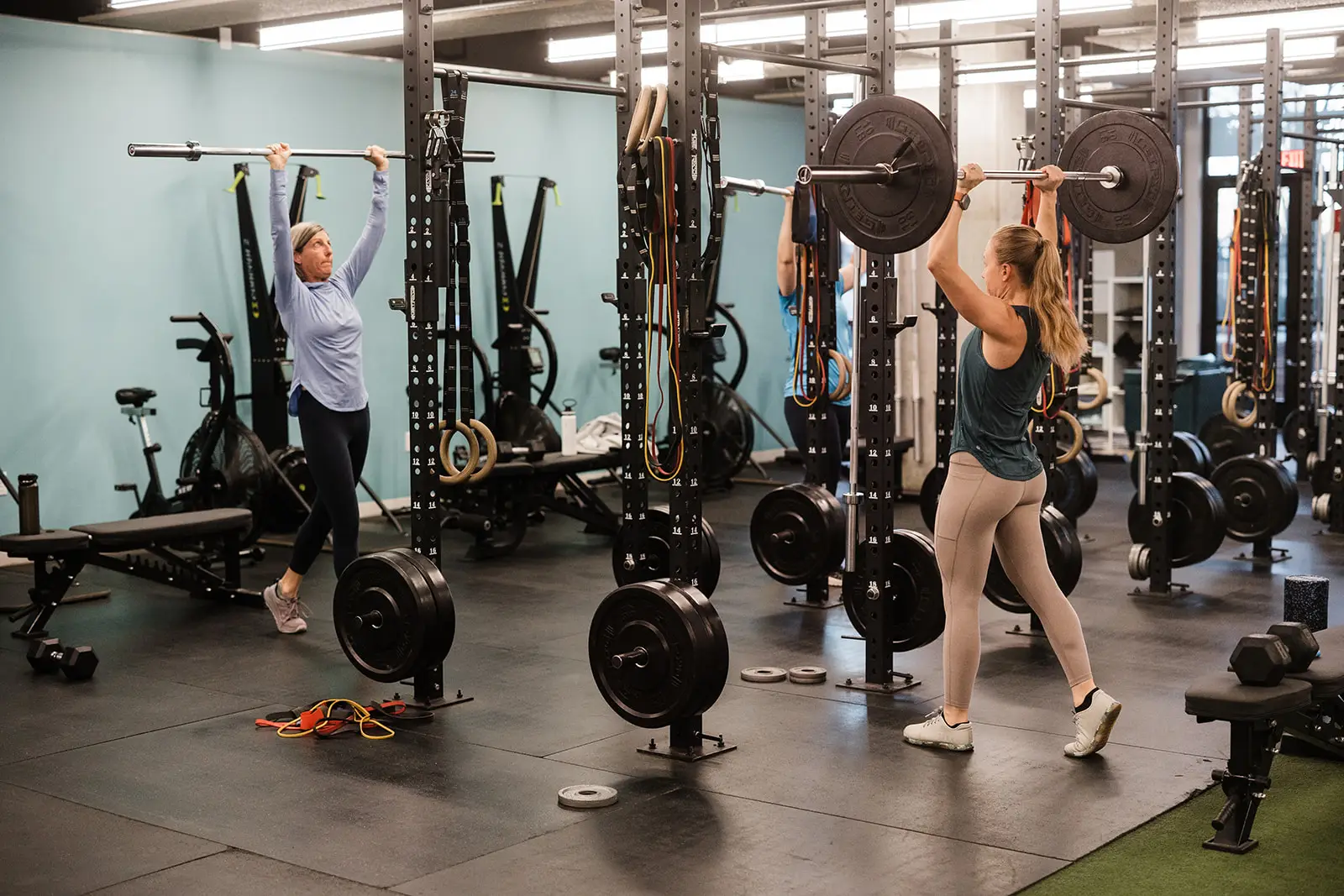
Heavy weights, eventually. External load should be the foundation of training — for strength, muscle, bone, performance, and injury risk alike. In the bone literature specifically, heavier loads produce a better response, with optimal benefits showing up around 75–80% of a one-rep max (O’Bryan et al., 2022). To be clear, that’s not where most women start. Give yourself three or four weeks to get comfortable and competent, then start adding weight.
Sets that actually get hard. Muscular fatigue is a primary driver of adaptation. Working close to the limit of what you can do with good technique is what tells the tissue to change and body to adapt. In practice: fewer than about 12 reps for most exercises, at a weight where the last rep slows down and is clearly effortful. As you finish the set, you might have been able to do between one to three more repetitions — not five.
Full body. Lower body, upper body, core, and movements in different directions. Not one body part per day, but meaningful exercises that translate to the demands of your life. We prefer free weights for most people because they ask your system to move and work cohesively.
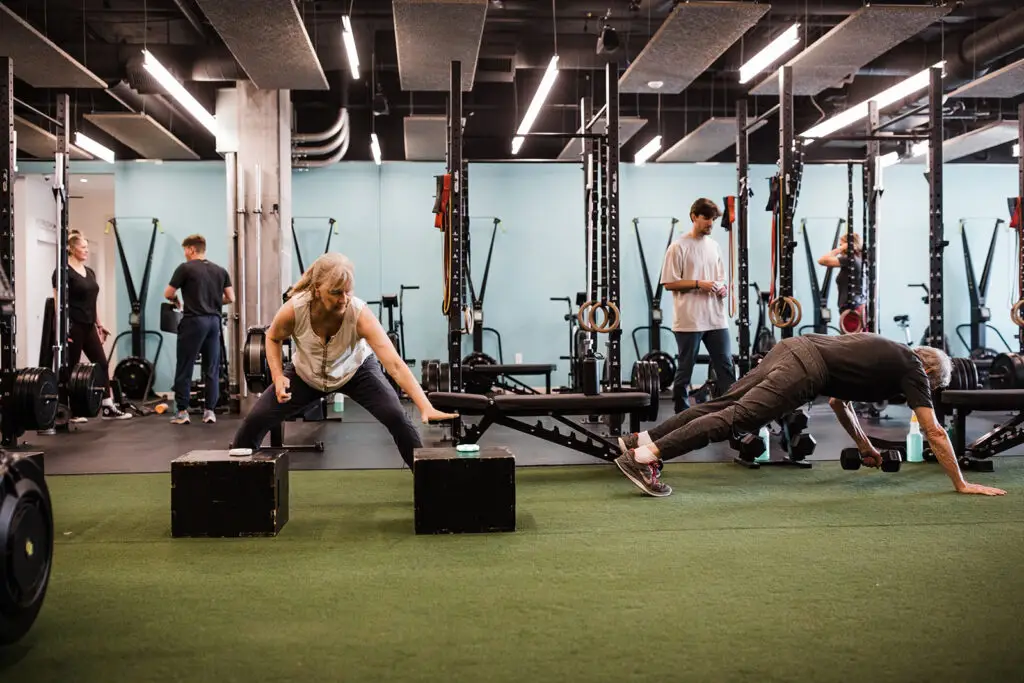
Impact and velocity. Jumping, hopping, skipping, landing. Short bursts of force build bone in a way hiking and running don’t, and this kind of training improves fall-risk measures better than other types (Vetrovsky et al., 2019). Movement competency always comes first, and we typically spend a few weeks getting comfortable before introducing any jumping or hopping.
Changing direction. Shuffling, pivoting, hopping sideways, controlling a single leg. Moving in different directions also helps develop strong bones. We see this in kids, and the same idea is true in adults: teens who play multidirectional sports tend to carry stronger bones decades later. It’s never too late to start.
Two to three hard sets of key exercises Benefits keep accruing past that, but with gradually diminishing returns. Choose four to six movements per session that meet the criteria listed above.
Twice a week. A meta-analysis of 151 randomized trials found that even low-volume resistance training produces significant, durable gains in strength and lean mass (Radaelli et al., 2025). Two sessions is a real program, not a compromise. About an hour each is sustainable, and it’s how we structure our classes.
Go deeper on any of this:
- What strength training actually is — the vocabulary, if you’re starting from zero
- Strength training myths and misconceptions — getting bulky, safety, and many more common myths
- Staying athletic after 40 — why “sore, stiff, and achy” usually isn’t about age
- Jumping for active adults — the impact and power piece, in detail
- Why runners need strength training — if your week is already full of cardio
“As someone who’s trying to slide confidently into her 40s, Evolve has delivered a trifecta of benefits: strength, endurance, and mental fitness!”
— Katharine Smith
Why you were sold the opposite
If you’re 45 and unsure whether it’s safe to lift heavy, that isn’t a gap in your knowledge. It’s the predictable result of what the fitness industry sold women for fifty years: that light weights and high reps produce a “long, lean” body, that heavy lifting makes you bulky, and that the point of exercise is to become smaller.
All three are wrong, and we take particular issue with the last point.
Muscle and bone weigh something. When people lose weight, anywhere from 10% to 25% of what is lost is muscle and bone. Because there are countless negative potential consequences of muscle and bone loss, this makes, in our view, weight-focused programs genuinely risky past 40, when rebuilding that tissue is already harder. If the goal is more muscle and denser bone, the scale is the wrong instrument for telling you whether it’s working.
The safety argument is also backwards. Never learning to handle heavier loads is what makes ordinary life feel risky. If you’ve never lifted 50 pounds in the gym, handling a checked suitcase or Costco-sized bag of dog food might be legitimately challenging, if not injurious. But if you can lift 75lbs, or 100lbs, or more, it becomes an afterthought.
We’ve met a lot of women who exercised diligently for decades and got very little of the protection they were promised. At EVOLVE Flagstaff, we want to change this.
More on this, from us:
- The smoke and mirrors of diet culture — the insidious lies that diet culture tells us
- You don’t have to earn your food — the story that needs to disappear, ASAP
- Eat more, not less — what under-fueling costs you in the gym
- Do fitness better — why fitness focused only on weight loss takes away its true power (and yours)
Need More Help?
Are looking to stay strong, active, and healthy as you age?
EVOLVE Strong classes have all the elements women need to do exactly that.
Why this matters more in Flagstaff
Flagstaff asks a lot of a body, and because we live here this is easy to forget. Descending Elden is 2,400 feet of your quads absorbing force over thousands of steps. Then there’s snow shovelling (hopefully), skinning up Snowbowl, Sedona riding, and so much more.
We demand a lot from our bodies, and we want to continue to do so well into our later years. This means we need strength training.
Endurance athletes have a particular blind spot here. Cardiovascular exercise is essential, but it’s not enough on its own. Running, riding, and skinning are excellent for your heart and do almost nothing for your strength, muscle, or bone. It’s entirely possible to have outstanding cardiovascular fitness while quietly losing the tissue that keeps you independent at 75.
We live here, too, and that’s why we’ve designed our strength training classes to build the well-rounded, functional strength that Flagstaff locals need.
What stops women from starting
“I’ll get bulky.” You almost certainly won’t, for physiological reasons rather than motivational ones. Women have a fraction of the circulating testosterone men do, and most of your first-year strength gains are neural — your nervous system learning to use what you already have. You’ll get noticeably stronger long before you look different. Visible muscle is slow and hard-won; it does not happen by accident. And, to be frank, if you do start to put on muscle — that’s amazing! As you age, building muscle is one of the most beneficial things you can do for your health and performance.
“I’ll get hurt.” Resistance training is remarkably safe, even with heavier weights. Across analyses of more than 38,000 participants, serious adverse events were not elevated, and nonfatal cardiovascular complications occur less often than in aerobic exercise. A 2026 meta-analysis found no difference in adverse events or falls between high-intensity (≥70% 1RM) and lighter training in adults over 50. For context: recreational running carries an overuse injury rate around 40%, much higher than strength training. But nobody warns you about that one, especially in Flagstaff.
And the light-weight world isn’t safer — we’ve seen as many injuries come out of barre, body pump, and home workouts as out of barbell training. The weight usually isn’t the problem; it’s usually movement technique, or pre-existing factors.
If you have an current injury or a painful joint, you don’t have to solve it before you start — begin with physical therapy and we’ll build the bridge into training from there.
“I’ll feel out of place.” This is the one we hear most, and the one nobody writes about, so we wrote a whole piece on walking into a gym for the first time. At EVOLVE, we specialize in working with people who are new to the gym. If you’re “not a gym person,” you’re our people.
“I started training at Evolve after hip surgery about 4 years ago. I’ve weight trained most of my life and this is by far the best experience I’ve had in Flagstaff — an inclusive atmosphere for anyone from athletes to newbies.” — Becky P.
Want to start on your own?
You can, and plenty of people do. We’d rather you train somewhere than nowhere.
- A basic full-body strength program — free program with minimal equipment
- A basic strength program for runners — another free program, tuned for runners
- How to run a workout — sets, rest, effort, and how to progress
- Ten-rep anchor set — our favorite way to find the right weight
However, a number of things can trip people up, especially if you are new to training. Peer-reviewed research shows that individuals who are new to training see slower results and are less likely to be consistent than those who attend a class or work with a personal trainer.
It can also be hard to progress a training program on your own, or introduce variety in the right way: enough to keep things interesting, but not so much that your sessions are random.
Why you should consider a strength class
We wrote an entire article about why you should take a strength class, rather than trying to figure all of this out on your own.
It’s entirely possible to train effectively on your own, and we don’t want to put more barriers between women and strength training.
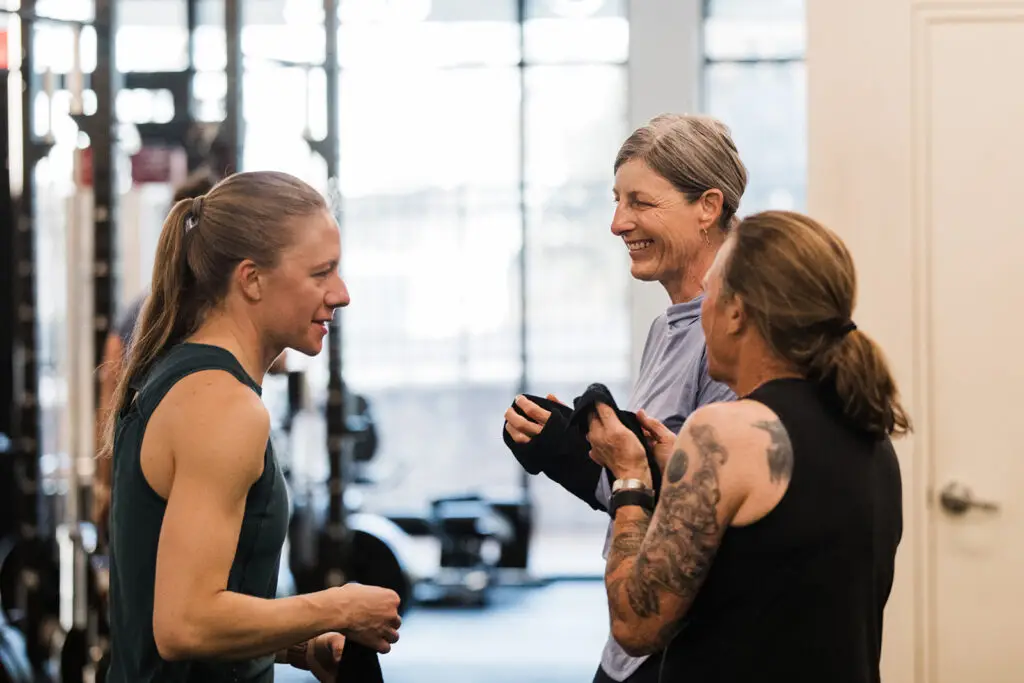
But classes provide accountability, structure, coaching, variety, progression, intensity, and community. A quality strength class is an incredible investment in your long term health.
EVOLVE Strong is the ideal program for most women who don’t have any current injuries. It’s accessible to beginners, but provides a real challenge for more experienced athletes. Every class runs has an intentional structure that covers all of the key areas we listed earlier. Come try your first class for free.
Need More Help?
Are looking to stay strong, active, and healthy as you age?
EVOLVE Strong classes have all the elements women need to do exactly that.
If you’re coming back from an injury, managing a chronic condition, or are relatively new to movement and exercise in general, then Foundations would be a great fit, and you can move to the Strong classes as you get comfortable.