
Most people who want to get stronger already have a plan. Find some time in the week, get to the gym, do some stuff, go home. Repeat.
And most people have watched that plan fall apart. A busy week, a late night, a morning when the bed wins. A few skipped sessions turn into a few skipped months.
If that sounds familiar, the problem probably isn’t you. It’s the plan.
Here’s what the research shows: adults who train in coached workout classes show up more consistently, work at an effort that produces results, learn better technique, and stick with training far longer than people who go it alone. A class removes most of what quietly derails solo training: deciding when to go, figuring out what to do, guessing how hard to push, and wondering whether your form is right.
If you have goals that strength training supports (long-term health, staying active in the mountains, supporting your running or riding, reducing injury risk) but think “I’m not a group class person,” this is for you.
New to strength training? Our guide to what strength training is and how to start covers the benefits, the basics, and how often to train.
A Class Removes the Decision to Go
Intending to exercise and having a specific, protected time to exercise are not the same thing. People who commit to a particular day and time, treating training like an appointment rather than something they’ll get to when things slow down, follow through at much higher rates.
There’s a time on the calendar, a coach expecting you, and other people training alongside you. That isn’t a gimmick. It’s how structure works.
A coach and a group at 6 a.m. expecting you is different from a general intention to train sometime Tuesday. One of them reliably happens. The other usually doesn’t.
“After trying out other ways to be consistent and getting a good workout, the strong classes at Evolve is what works for me.”
–Enoque, EVOLVE member
A Class Removes the Guesswork on Effort
Here’s something research confirms again and again, and any experienced coach could tell you from watching: people left to their own devices tend to train below the level that produces meaningful results.
This isn’t about motivation. It’s about calibration.
For strength and muscle to improve, training intensity generally needs to reach about 60–75% of your maximum on a given exercise. In two well-designed studies, novice lifters choosing their own loads landed between 40% and 57% of their maximum, consistently below that threshold, while rating the effort as “somewhat hard.”¹ ² They weren’t slacking. They just had no way to know they weren’t working hard enough.
Coaching changes this. (Research calls it “supervision.”) A 2000 study comparing supervised and unsupervised resistance training found the supervised group lifted significantly heavier loads over 12 weeks and finished with greater squat and bench press strength.³
A 2014 study at a Southern California fitness club randomly assigned men to either coached, structured training or training on their own, both three days a week for 12 weeks. The coached group gained lean muscle while the self-directed group didn’t change, and the coached group’s chest press strength improved more than twice as much (42% vs. 19%).⁴
Same schedule. Very different results.
A good coach doesn’t just push you harder. A coach calibrates what “working hard” looks like for your body, on this exercise, on this day, and adjusts when it isn’t right.
Feeling less athletic than you used to? How to stay athletic after 40 explains why stiffness, aches, and lost speed aren’t just aging, and what to train instead.
A Class Removes the Worry About Your Form
Squatting, hinging, pressing, and pulling are skills. They take coordination, body awareness, and feedback to learn well. Most adults can safely start training on their own, but coaching helps you keep making progress without stalling or getting hurt.
Even the choice of exercises matters. In an expert consensus study, strength coaches and researchers agreed that some exercises are better starting points for beginners than others.⁵ Picking the right ones for you is part of a coach’s job. And expert guidance on technique can speed up learning and improve safety. There’s also fascinating research showing that people exercising together naturally sync their movement and even their breathing, a kind of unconscious calibration that supports learning and effort.⁶
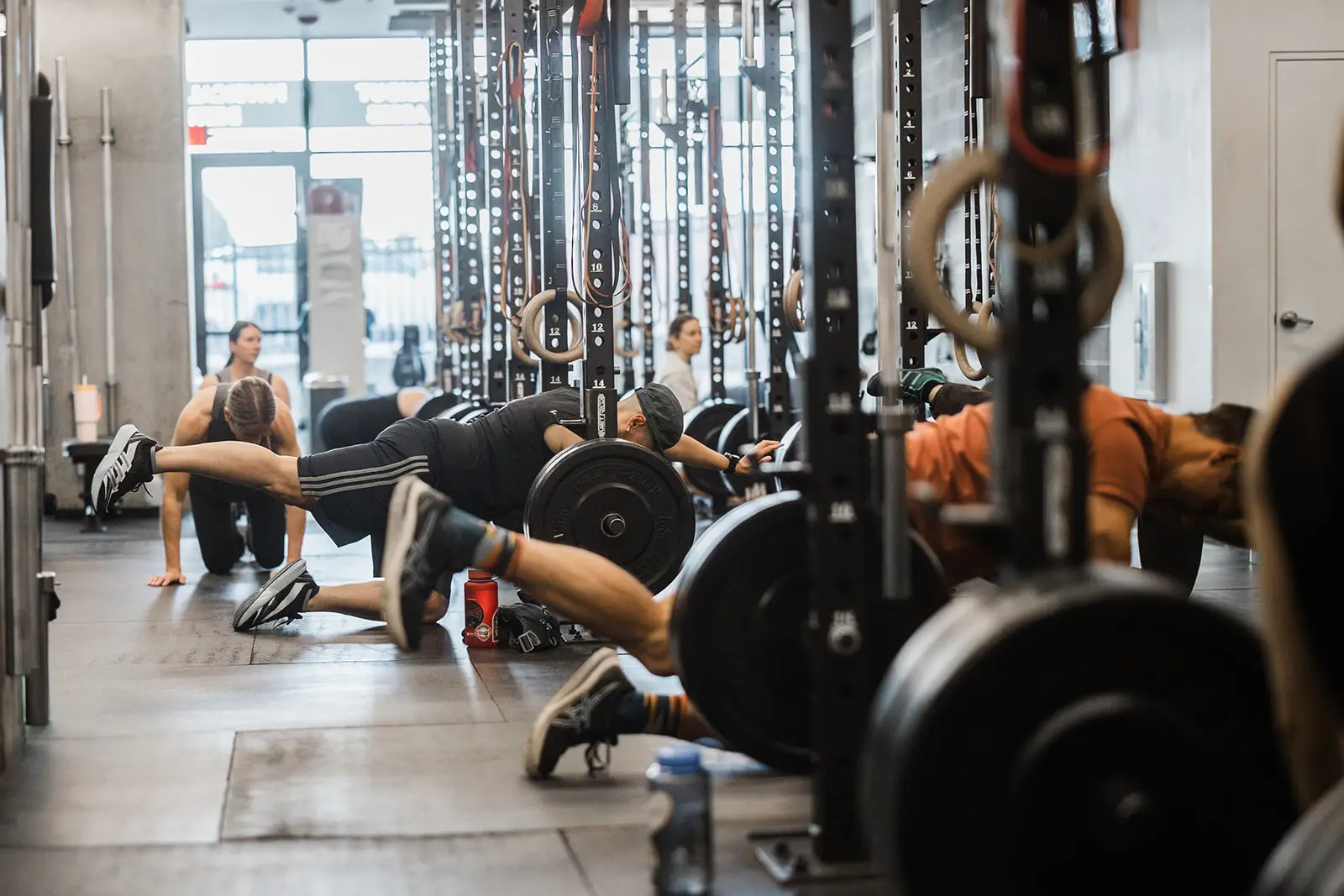
In a coached class, you get expert eyes on your movement and corrections in the moment, before a poor pattern becomes a habit or a sore knee. When an exercise doesn’t suit your body that day (an old knee issue, a shoulder that’s flaring up), a good coach adjusts on the spot.
Group Fitness Classes Help You Stick With It
Roughly half of people who start an exercise program stop within six months.⁷
People who exercise in groups with a coach stick with it significantly longer. Feeling connected to the people you train with, and invested in a shared goal, is one of the strongest predictors of continuing.⁷ ⁸ In one study, how connected people felt to their exercise class after just three weeks predicted who was still showing up and who had dropped out.⁹
People often imagine they’ll be more consistent on their own, with no schedule to work around and no one watching. Unfortunately, what usually happens is they stop.
“Evolve has helped me be consistent with strength training for the first time ever.”
-Natasha W., EVOLVE member
You’ll Probably Enjoy It More Than You Expect
If you’re skeptical about workout classes, you’re in good company. That skepticism may say more about a known mental bias than about you.
Research on affective forecasting, our ability to predict how we’ll feel about future experiences, shows people consistently underestimate how much they’ll enjoy social activities. In nine experiments, participants predicted they’d have a better time alone, then reported the opposite after spending time with others.¹⁰
So the decision not to try a class is usually made before the experience. The prediction feels accurate. The data says it usually isn’t.
There’s a bigger reason too. The U.S. Surgeon General’s 2023 advisory named loneliness and social isolation a public health crisis. About half of American adults reported meaningful loneliness, and poor social connection raises the risk of heart disease, stroke, and dementia.¹¹ Training alongside other people does two good things for your health at once.
Nervous about walking in? How to overcome gym anxiety walks through why gyms feel intimidating and practical ways to make your first visit easier.
Men, We Need to Talk
Men are less likely to seek help with their health across the board: about a third less likely to see a doctor, and more likely to wait out symptoms.¹² The “I’m not a group class person” identity tends to run especially strong in men.
Group fitness has mostly been marketed to women. Don’t get us wrong, strength training is important for women, particularly after 40 and around and after menopause. But a well-programmed strength class built on compound lifts, gradually heavier loads, and hard effort in a supportive room isn’t gendered. What it does have, based on the research, is better outcomes.
What an EVOLVE Strong Class Looks Like
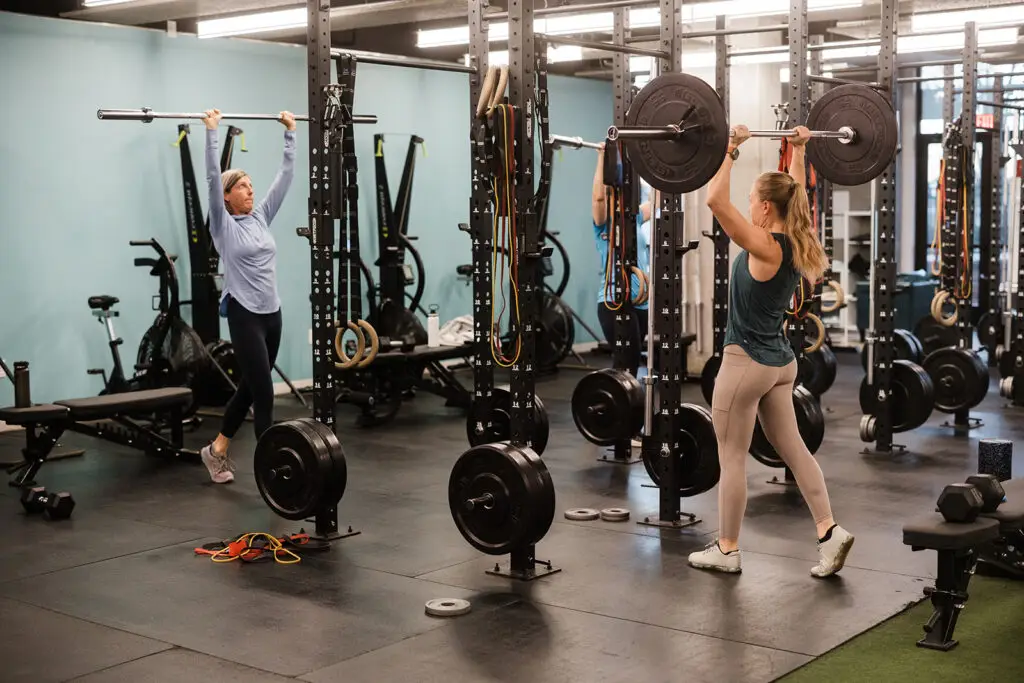
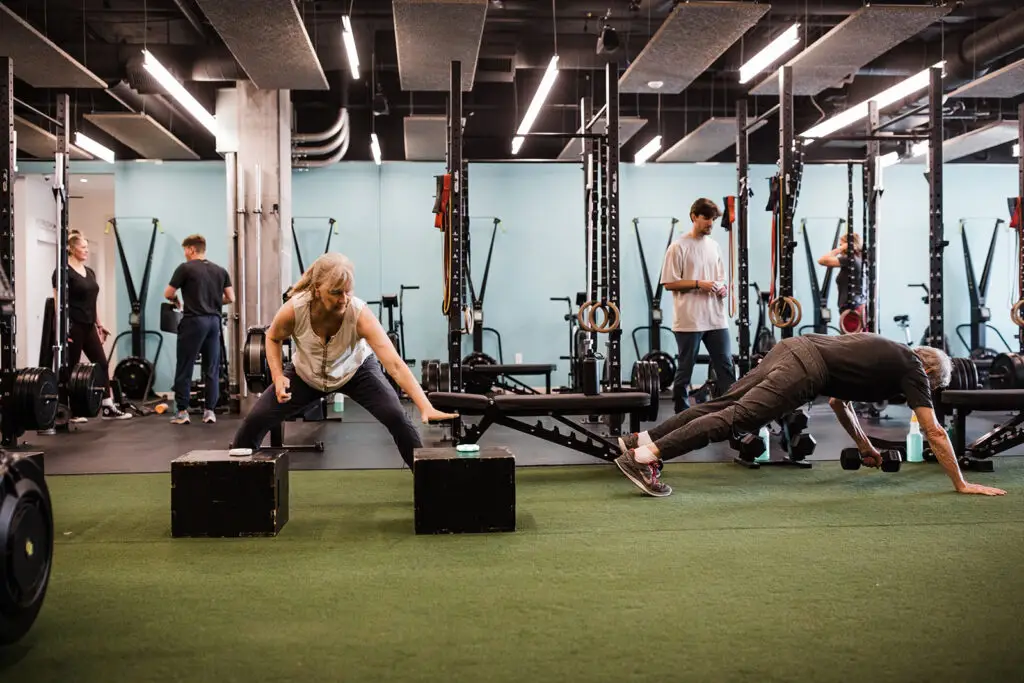
On your first visit, your coach greets you, shows you around, and answers whatever questions you have. Then the coach leads the group through a warm-up and three blocks.
Strength
Upper and lower body strength movements. Your coach teaches the technique, shows options for different levels, and comes around to help with form and choosing the right weight. Rest between sets is built in.
Resilience
Core, balance, agility, and stability work: the pieces that help prevent injuries and keep you steady on the trail.
Conditioning
A block that raises your heart rate and builds muscular endurance. Exercises done while you’re out of breath are chosen with safety in mind, so you won’t be asked to do complex lifts when you’re gassed.
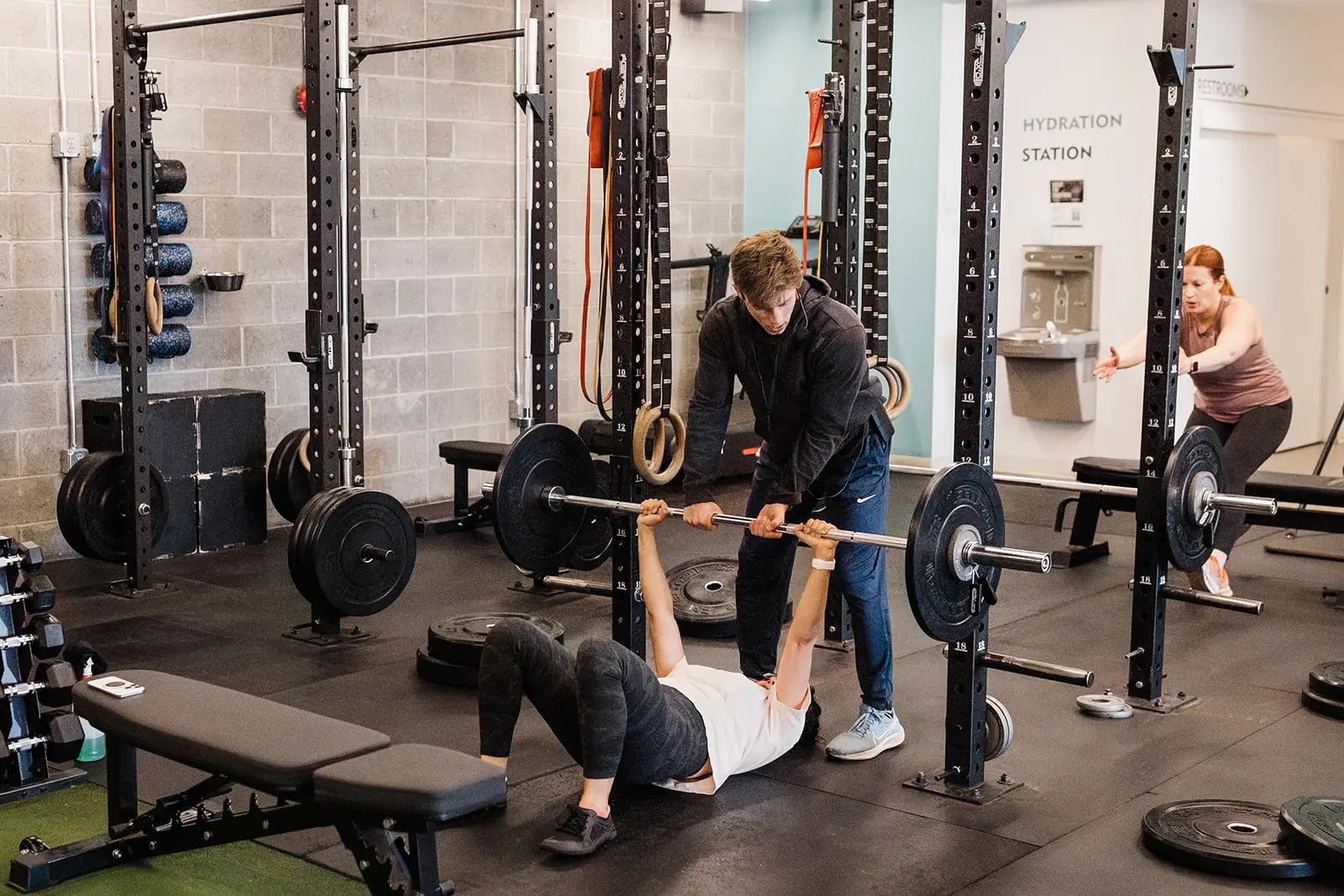
Classes are capped at 15 people. The workout changes daily and is balanced across the week, so whichever days you come, you get a complete program. Most members come two or three times a week.
The other people in the room are Flagstaff adults, mostly from their late 20s to early 60s, who like being active outside the gym. They’ll help you feel at home. The music is upbeat, and no question is a silly one.
“Difficult, yet fun and safe, exercise classes.”
-Melissa Y., EVOLVE member
Who Doesn’t Need a Class
To be fair, some people do fine without a coached group. They’ve trained on their own for years, enjoy designing and managing their own program, are confident in their technique at high effort, adjust when something feels off, and push hard without anyone watching.
They’d train just as hard in a cold garage at 6 a.m. in January as anywhere else. These people exist, but they’re rare. If that’s you, our basic full-body strength program is a solid place to start. Even then, you might enjoy the company.
A class of 15 also isn’t the best first step if you’re in the middle of rehab from an injury. There’s a smaller option for that, covered below.
Most people, including many who are sure they prefer training alone, do measurably better with a coach and a group.
What If Classes Don’t Fit My Schedule?
Some people can’t make a fixed class schedule work: demanding jobs, shift work, kids, travel. If that’s you, everything above still applies.
A packed calendar is exactly where a loose plan to “get to the gym when I can” disappears. The answer isn’t training without structure. It’s finding structure that fits your life.
For most people in this position, we recommend personal training, usually four sessions a month to start. A trainer can work around your schedule while still giving you accountability, real programming, and coaching that adapts to you. At EVOLVE, personal training packages include open gym access and classes, so your sessions become the fixed anchor and everything else fills in around them.
You Don’t Have to Be Ready First
Before trying a class, we often hear, “I need to get in better shape first.”
That’s backwards. The class is where you get in better shape.
Our strength training classes in Flagstaff are built for every experience level, from people who’ve never touched a barbell to athletes who’ve trained for years. If you have an injury, a chronic condition, or a lot of anxiety about gyms, our Foundations semi-private training is a smaller group built for that transition.
The gap between where you are now and “ready to start” isn’t one you close on your own first. You close it by starting.
Come try a free class. Worst case, you confirm it’s not for you. Based on everything above, that seems unlikely.
Make Consistency The Easy Part
Try your first EVOLVE Strong class free.
A set time on your calendar, a coach to guide every workout, and a plan that’s already built for you. No experience needed.
References
- Glass SC, Stanton DR. Self-selected resistance training intensity in novice weightlifters. J Strength Cond Res. 2004;18(2):324–327.
- Ratamess NA, Faigenbaum AD, Hoffman JR, Kang J. Self-selected resistance training intensity in healthy women: the influence of a personal trainer. J Strength Cond Res. 2008;22(1):103–111.
- Mazzetti SA, Kraemer WJ, Volek JS, et al. The influence of direct supervision of resistance training on strength performance. Med Sci Sports Exerc. 2000;32(6):1175–1184.
- Storer TW, Dolezal BA, Berenc MN, Timmins JE, Cooper CB. Effect of supervised, periodized exercise training vs. self-directed training on lean body mass and other fitness variables in health club members. J Strength Cond Res. 2014;28(7):1995–2006.
- Kompf J, Rhodes RE, Lee S. Selecting resistance training exercises for novices: a Delphi study with expert consensus. Am J Lifestyle Med.
- Codrons E, Bernardi NF, Vandoni M, Bernardi L. Spontaneous group synchronization of movements and respiratory rhythms. PLoS ONE. 2014;9(9):e107538.
- Maher JP, Gottschall JS, Conroy DE. Perceptions of the activity, the social climate, and the self during group exercise classes regulate intrinsic satisfaction. Front Psychol. 2015;6:1236.
- Dunlop WL, Falk CF, Beauchamp MR. How dynamic are exercise group dynamics? Examining changes in cohesion within class-based exercise programs. Health Psychol. 2013;32(12):1240–1243.
- Spink KS, Carron AV. Group cohesion effects in exercise classes. Small Group Res. 1994;25(1):26–42.
- Epley N, Schroeder J. Mistakenly seeking solitude. J Exp Psychol Gen. 2014;143(5):1980–1999.
- U.S. Department of Health and Human Services. Our Epidemic of Loneliness and Isolation: The U.S. Surgeon General’s Advisory on the Healing Effects of Social Connection and Community. 2023. https://www.hhs.gov/surgeongeneral/reports-and-publications/connection/index.html
- Sandman D, Simantov E, An C. Out of Touch: American Men and the Health Care System. Commonwealth Fund Men’s and Women’s Health Survey Findings. 2000.