
Physical Therapy That Actually Solves Your Problem
Pain or injury keeping you from running, hiking, climbing, or just living your normal life?
Stuck with random exercises, but no solutions?
Symptoms return just when you thought things had healed?
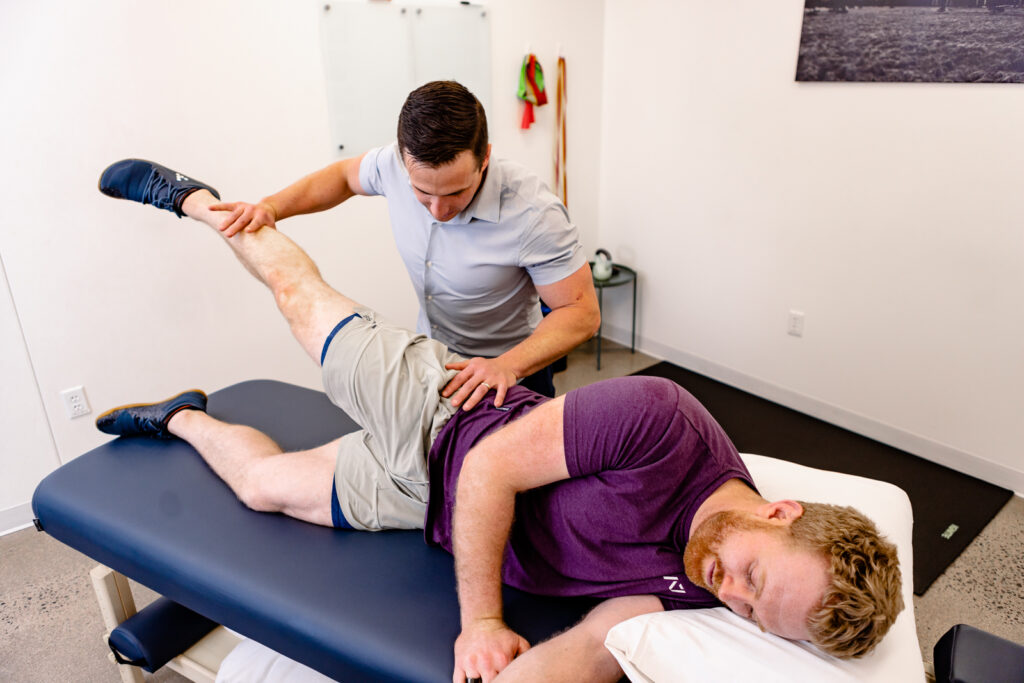
At EVOLVE, we help you understand the full picture — not just what hurts, but why — then build a plan specific to your situation and your goals.
Who the EVOLVE Physical Therapy is For
You're Hurting and Nothing's Worked
- Pain or injury that hasn't resolved on its own.
- You've tried rest, stretching, or a previous round of PT without much success.
- You aren't sure what's actually wrong — or why it keeps coming back
You've Been Given Generic Treatments
- Appointments with an aide, not a Doctor of Physical Therapy.
- A handout of exercises that didn't seem connected to your situation.
- Progress that was slow, unclear, or just… not there.
You Want to Get Back to What You Love
- You want a clear path to progress — not just "keep doing your exercises."
- The demands of your activities haven't been part of the conversation.
- You're worried about loss of fitness as you heal.
Physical therapy at EVOLVE is one-on-one care with a Doctor of Physical Therapy, every single session. No aides, no assembly-line treatment, no generic protocols.
If you’ve done PT before and walked away frustrated — and still hurting — let’s figure out why.
The EVOLVE Physical Therapy System
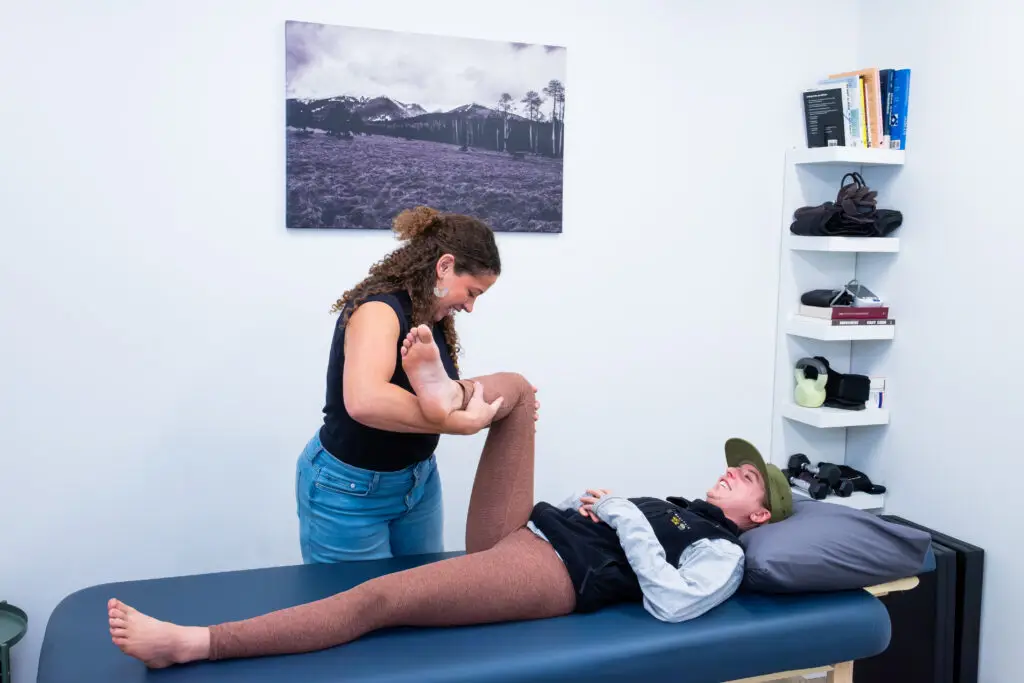
Not all physical therapy is equal. Most follow generic protocols in short appointments, without clear testing or a process to ensure you get better. At EVOLVE, we have a specific system that allows us to address the full picture — not just the painful spot — while personalizing our approach to you.
1. Accurate Diagnosis
Before anything else, we need to know what’s actually hurt — what tissue is involved, how it’s behaving, and what’s keeping it aggravated. This might seem obvious, but many cases where “PT didn’t work” had an incomplete or incorrect starting point. Accurate diagnosis doesn’t require an MRI — it requires a thorough history and a skilled physical examination.
2. Manage and Monitor Triggers
Most healthcare is focused on what you should do. It’s equally important to understand what to modify, monitor, or temporarily avoid. Think of it this way: if you keep hitting your thumb with a hammer, it doesn’t matter how much you strengthen it — it will keep hurting. Many people are given exercises without anyone exploring what’s continuing to aggravate the injury. We identify those triggers early and work with you to manage them, without defaulting to rest or inactivity.
3. Change How You Move
How you move throughout the day and during activity directly affects how tissues load and recover. We assess movement patterns — not just the painful area — because the way you move is often part of why something got hurt in the first place. If you have pain on the outside of your foot while running and we find that you consistently land on that side, changing that movement pattern will likely be part of the solution. Most of us are never taught how to move well, and this is central to our approach.
4. Nervous System and Whole Body Health
Recovery isn’t purely mechanical. Stress, sleep, anxiety, fear of movement, and injury history all shape how your body responds to pain — and how quickly you recover. When these factors are relevant, we address them directly. When it makes sense, we bring in other EVOLVE team members, such as a Registered Dietitian.
5. Progressively Build Capacity
With a clear diagnosis, triggers identified, movement addressed, and systemic factors considered, we build from there — systematically increasing strength, endurance, and capacity. We work toward the actual demands of your life: running, lifting, climbing, hiking, biking, whatever you do. We test along the way so there’s no guessing about whether you’re genuinely progressing.
6. Build a Long Term Plam
One of the most common mistakes in PT: stopping as soon as the pain goes away. Pain resolving is a starting point, not the finish line. Before you’re done, we make sure you understand what contributed to the injury, what led to improvement, and what to monitor or continue so you can stay active long-term.
If you’re dealing with pain or injury — especially if you’ve already tried PT that didn’t quite work, we’d love to help.
Don't just trust us...
Hear from real Flagstaff people who have been through our physical therapy process.
Long Term Strength After Back Pain
“The knowledge of the anatomy and more specifically the nerve issues I am having in my back was well understood and [provided] a clear plan of how to come back stronger.
I also feel great that the road forward with Evolve doesn’t just end at the acute rehab from surgery but rather a long term conditioning and goal to be better than before this injury.”
— Harlan T.
Empowered and Back to Activity
“Two things really stand out for me – one is his approach is focused on the activities I love and getting me back to a place where I can do them. The other is that he is really focused on patient knowledge and empowerment – the idea is that I am with my body for way longer than he is, so he spends time teaching me what is going on and how to best care for it.
My sprained ankle felt SUCH a lower pain level after just one visit with him – it was amazing”
— Dylan Q.
Building an Invincible Body
“…basically the mechanic I turn my body over to after I’ve abused it. [We’ve] treated injuries to my knees, hips, wrists, shoulders and lower back.
I keep finding new ways to fall… [they] keep finding ways to make me stronger and keep me from re-injurying the same area. I plan to be invincible around 55.”
— Kiel O.
Frequently Asked Questions
Have hesitations? Let’s talk about them.
Do you work with my insurance?
EVOLVE does not work directly with any insurance companies. But, before you search for a different clinic, let’s unpack what that means, and why out-of-network may actually be a better option.
When a clinic contracts with insurance companies, those contracts shape how care is delivered: appointment length, visit frequency, what treatments are covered, and how quickly cases turn over. The result is often short appointments, care delivered by unlicensed aides, and treatment plans built around what insurance will approve rather than what you actually need.
Out-of-network PT doesn’t answer to those constraints. At EVOLVE, every session is directly with a licensed Doctor of Physical Therapy. Appointments are thorough and detailed. Your plan is built around your situation and your goals — not a billing code.
We can provide an itemized receipt (called a “superbill”) after each visit that you can submit to your insurance company for potential out-of-network reimbursement.
How does the cost of PT at EVOLVE compare to in-network clinics?
“Do you take my insurance?” seems like the right question. It isn’t — at least not if what you actually want to know is what you’ll pay. Health insurance billing is more complicated than most people realize, and the details matter.
Here’s what to actually ask when considering the cost of physical therapy:
What is my deductible, and have I met it? Your deductible is the amount you pay out of pocket each year before insurance begins covering costs. Most plans have separate in-network and out-of-network deductibles, with the out-of-network deductible being higher. If you haven’t met your deductible, you may be paying the full cost of every visit — even at an in-network clinic.
Is physical therapy covered before my deductible? Some services, typically preventive care like annual checkups, are covered before you meet your deductible. Physical therapy sometimes is, but often isn’t. This varies significantly by plan. Call your insurance company and ask specifically whether PT is subject to your deductible before you book anywhere.
What does the clinic actually bill my insurance? This is where it gets counterintuitive. In-network clinics negotiate contracted rates with insurance companies — but those negotiations start from the clinic’s submitted charge. To maximize what they’re paid, clinics typically submit inflated charges: $300 to $500 or more per visit is common, even when the contracted rate ends up much lower. Clinics aren’t acting maliciously — this is simply how in-network billing works. But it means the billed rate and your actual cost can be very different numbers, and if you haven’t met your deductible or have a coinsurance responsibility, you may end up paying based on the higher figure. Most patients don’t find this out until the bill arrives.
When will I be billed? Insurance billing takes weeks — sometimes months. It’s common for people to finish a course of PT assuming their costs were low or covered, then receive a significant bill long after their last visit. If you have a high or unmet deductible, this can be a real surprise.
Do I have a copay or coinsurance? A copay is a fixed amount per visit. Coinsurance is a percentage — which brings you back to the question of what the clinic billed and what your plan allows. Read your benefits summary carefully, and don’t assume a copay is all you’ll owe.
How many visits should I expect? There’s a per-session cost, but also a cumulative one. Two visits per week for 6–8 weeks is a common in-network plan — that’s 12–16 visits, with the time commitment to match. Whether that leads to a real resolution is a separate question.
At EVOLVE: We charge a flat rate per session. You know the cost before you walk in — no billing delays, no surprise invoices, no numbers you can’t see until months later.
- Initial Evaluation: $165
- Follow-Up Visit: $130
- HSA and FSA cards accepted
We provide an itemized receipt (superbill) after every session that you can submit to your insurance company for potential out-of-network reimbursement. Most conditions resolve in 4–5 sessions over 6–10 weeks.
For most people, in-network or “taking your insurance” does not equal “free.” When you are motivated to get better but have financial constraints, it’s worth running the numbers — the difference is often smaller than people expect.
What does PT at EVOLVE cost?
EVOLVE has a set rate for each session:
- Initial Evaluation: $165
- Follow-Up Visit: $130
- HSA and FSA cards accepted
We can offer a sliding scale for individuals experiencing financial hardship.
Do I need a referral?
No. Arizona is a “direct-access state,” which means that you can see a physical therapist without a physician referral. Just book an initial evaluation and we’ll get started right away
Do you work with Medicare patients?
Due to Medicare rules and restrictions, we generally are not able to work with patients who have Medicare, even if you pay out of pocket.
Medicare regulations are complex, but under most circumstances healthcare providers cannot accept cash payment from Medicare patients for covered services — and physical therapy is typically covered. This is true even if the provider has no relationship with Medicare.
However, Medicare does not cover gym, fitness, or strength training services. We can (and do!) work with patients with Medicare to help you get started on an appropriate fitness program. Our physical therapists can do a movement and fitness assessment, and then help you to transition into either personal training or Foundations semi-private training.
If you’re in this situation, reach out and we’ll talk through the options.
What conditions do you treat?
Our physical therapy team can treat a wide range of orthopedic, neurological, and vestibular conditions. We can also offer a second opinion on existing diagnoses.
Common conditions and issues include:
- Foot and ankle pain — plantar fasciitis, Achilles tendon pain, ankle sprains, posterior tibialis tendinopathy, peroneal nerve pain, tibial nerve pain, big toe pain
- Knee injuries — patellar tendinopathy, IT band pain, plica syndrome, meniscus issues or tears, medial or lateral collateral ligament injuries, post-surgical rehab
- Hip pain — impingement, bursitis, gluteal or hamstring tendinopathy, groin or adductor pain
- Low back and SI joint pain — disc issues including bulges, herniations, or radiculopathy, facet joint pain or arthritis, and stenosis
- Shoulder and rib injuries — rotator cuff tears or tendon pain, biceps tendinopathy, rib sprains, thoracic spine or scapular pain
- Neck or cervical spine pain — disc injuries, facet joint pain, stenosis, and migraines
- Elbow, and wrist injuries — tennis elbow, golfer’s elbow, carpal tunnel or cubital tunnel issues
- Running-related injuries including stress fractures
- Many other sport-related injuries: climbing, aerial arts, cycling, skiing, snowboarding, and more.
- Chronic pain and musculoskeletal conditions
- Vestibular issues including BPPV
- Pre- and post-operative management
Not sure if your situation is a fit? Don’t hesitate to reach out
Do I need a diagnosis before starting?
You do not need a diagnosis from another provider before starting. Our physical therapists specialize in diagnosing orthopedic pain and injury — figuring out not just what’s painful, but why it’s happening. Your initial evaluation includes a thorough clinical exam that looks at your movement, history, and contributing factors to get a clear picture of what’s going on.
If anything is still unclear after your first visit, your physical therapist will talk through it with you and recommend appropriate next steps.
Do I need an X-ray or MRI before starting?
No. In most cases, imaging isn’t necessary to start — and it often tells us less than you’d expect. Research has consistently found that X-ray and MRI findings like disc bulges, arthritis, and degenerative changes are common in people with no pain at all. That doesn’t mean imaging is never useful, but it does mean your symptoms and how you move are typically more informative than what shows up on a scan.
Your physical therapist will do a thorough clinical exam at your first visit. If imaging would genuinely change how we approach your care, we’ll tell you — and help you figure out what kind of imaging actually makes sense.
What if I've already done PT and it didn't help?
This is an unfortunate but common situation, but it doesn’t mean that physical therapy won’t work for you.
PT that doesn’t work usually comes down to a few things: an incomplete diagnosis, treatment that was too generic, not enough attention to how you move or what’s driving the problem, or a home program that wasn’t realistic or well-explained.
If you’ve been through PT elsewhere without getting where you wanted to go, we won’t just replicate what didn’t work. We’ll what you did, investigate your issue in detail, and help build a plan with a fresh perspective.
How many visits will I need?
It depends on what’s going on.
For most single-area injuries, 3–6 visits is a reasonable range. Post-surgical rehab and complex or long-standing issues typically take longer.
We’ll give you an honest estimate during your initial evaluation. Our goal is to help you get better as quickly as possible, and we’ll never encourage you to schedule more than necessary.
What should I expect at the initial evaluation?
The initial evaluation is 75 minutes. We’ll first spend time learning about you, understanding the history of your issue, and exploring your goals.
From there, we assess the area of concern, look at relevant movement patterns, and develop a clinical picture of what’s going on. You’ll leave with a clear explanation of what we found, what the plan is, and a home program to start right away.
What should I bring to my initial session?
Clothing:
- Wear clothes that are easy to move around in and are flexible around the affected area.
- For knee injuries, wear shorts or clothing that can allow for visualization of your knee.
Running-Related Injuries:
- Bring your running shoes.
- If you just got a new pair, bring the new pair and an older, well-used pain.
Medical and Injury History:
- Bring any documents relating to your current issue, such as prior physical therapy home plans, imaging reports, or physician notes.
- If you don’t have any or can’t find them, no worries. We can proceed without them.
Can my PT design a custom strength training program for me?
For many patients, a structured strength and conditioning program is a natural extension of physical therapy. Depending on your situation, this can complement your PT plan — keeping you training while you recover — or help you seamlessly move from rehabilitation into a longer term approach to improve performance and reduce risk of future injuries.
We offer Custom Program Design for patients who are ready to train independently: pain is under control, symptoms are predictable, and movement patterns are solid. Your PT can walk you through whether it’s a good fit and when the timing makes sense.
For patients who have less experience strength training on their own, we can also create a plan for our coaches to help you with in Foundations. This is included in the Foundations membership.
How Does Physical Therapy Work?
Most people know PT can help — what’s less clear is how and why. A few key principles drive the process:
- Reduce stress on the painful area: Injured tissue often heals when we stop repeatedly overloading it. Improving how you move gives the area a better chance to recover.
- Use resistance exercise to promote healing: Strengthening doesn’t just build muscle — it can also stimulate tissue-level healing.
- Restore and promote movement: Movement supports blood and lymph flow, bringing nutrients in and helping clear waste products.
- Calm the system: Hands-on therapy and soft tissue work can reduce local and whole-body sensitivity, ease guarding, and improve movement.
- Support the nervous system: Stress can slow healing and amplify pain, so whole-body health matters.
- Build long-term resilience: Better overall strength and fitness help your tissues handle more load before becoming painful.

The rehab industry is full of misleading narratives like “putting things back in alignment” or “breaking up scar tissue.” Our approach focuses on evidence-based treatment and collaborate problem solving to help promote long-term healing and resilience.
Not sure if we are the right fit, or have other questions?
We’d love to help. Click the button below to shoot us a note, and then we’ll set up a time to chat about your goals and the perfect plan for you.