
Nutrition Habit: Incorporate vegetables into 80% of your “eating occasions.”
I’m sure you’ve heard: eating vegetables is crazy important. They help keep you satiated, provide essential fiber, vitamins, and nutrients, and are just plain good for you. We find that most people, even if they think they eat healthy, don’t get enough. Federal recommendations suggest 2.5 cups of vegetables per day for women, and 3 cups for men. But, we find that can be hard to really visualize or track throughout the day. So our recommendation is to incorporate one or two big handfuls vegetables into 80% of your “eating occasions.” What does this mean?

- If you eat 5 times per day (3 meals and 2 snacks), at least 4 of these occasions must have vegetables.
- If you eat less than 5 times per day, try to have some vegetables at every meal! (3 meals out of 4 is only 75%).
There’s a subtle hint here: We’ve found that most people do better eating throughout the day, with a snack between meals. It helps keep hunger at bay and avoid overeating later.
Here’s a few ways to get your veggies:
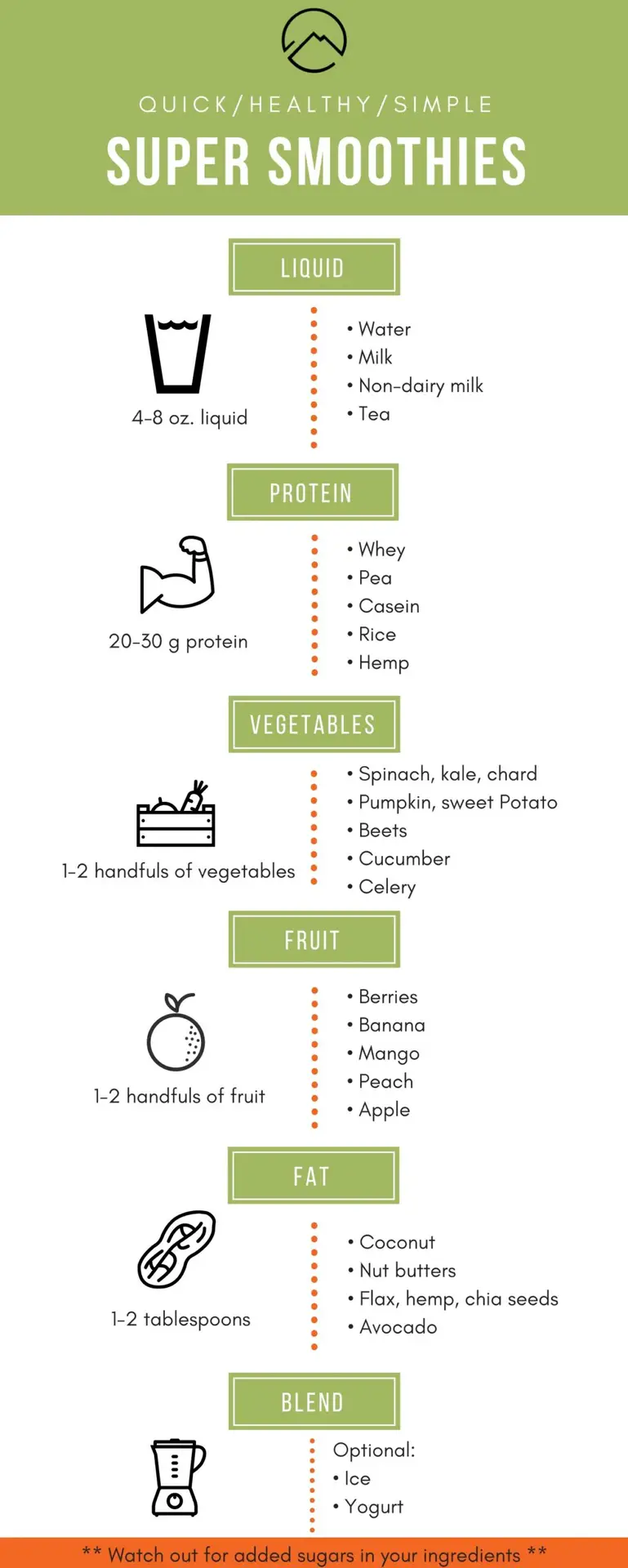
- Veggie smoothies! Check out the infographic for a template. These are great for a quick breakfast or snack
- Carrots, celery, and/or peppers: These travel easily, take little prep work, and taste great raw.
- Sautéed onions, mushrooms, spinach, and broccoli in scrambled eggs. This takes just a few minutes and is packed with nutrition. Or, try this frittata recipe.
- For the adventurous, try a breakfast salad with a light vinaigrette. You’ll feel like you went to a fancy brunch. It’s great!
Find a few things that work for you, and cycle them throughout the week.
Physical Habit: Get out of breath throughout the week!
Just like eating vegetables, doing cardiovascular exercise is crazy good for you. Here’s another infographic that breaks down all the benefits to your mental and physical health. Federal recommendations suggest at least 150 minutes of moderate intensity cardiovascular exercise every week, or 75 minutes of vigorous exercise, or some combination of the two. If you already do some exercise, set those numbers as a minimum goal. If you’re not exercise, it’s OK to take some time to work up to them. Try to get out of breath at least 3 days per week, and ideally 5 days.
Here’s some suggestions for getting in your cardio:
- Cycling: Road biking, mountain biking, or spin classes
- Running: Trail or road running, or the treadmill in a pinch. Here’s our guide to starting or getting back into running without injury (you can also adjust these times for any other activity, not just running)
- Power walking: Just be sure to get out of breath! Here’s a great walking program.
- Uphill or cross country skiing: We’ve been hurting for snow this winter, but it is great exercise!
- Workout classes: There are a lot of great options including Orange Theory and boot camp or circuit-training style classes
Just be sure that you’re getting out of breath! Our rules of thumb for exercise intensity are:
- Moderate: You should be breathing slightly hard, but able to say a sentence or two without gasping for a breath.
- Vigorous: You’re feeling out of breath, but you can still say a couple words at a time.
And one more pro-tip: If you’re tracking the amount of moderate and vigorous activity that you’re doing (most people do a combination), simply multiply your minutes of vigorous activity by two. Try to get to a total of 150 minutes.